
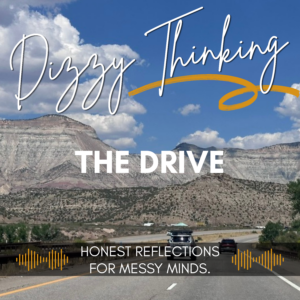
The Drive
 0
 0
Read Time:23 Minute, 30 Second
ON THE ROAD
The Drive
A story about spontaneous drives, old memories, and the thoughts that ride along.
By danney · 23 minute read
On this driveThe road to JuárezBefore I Was the One DrivingThe First Escape VehicleWhen Life Became LifeOtto and the Return of the Pointless DriveAll 37 TabsNot Every Drive Is NobleAlone With Them
When I was 18, I drove to Juárez, Mexico.
There wasn’t really a reason. At least, I don’t remember one.
Maybe I was chasing nostalgia. My family had taken one of our most memorable vacations through there a few years earlier. Maybe I needed to get away. Maybe I was bored.
Or maybe I was 18, had a driver’s license, and apparently thought crossing an international border by myself sounded perfectly reasonable.
I think I was driving a red Chevy Monza. I say “think” because time has never been my best gauge. I can remember the feeling of an afternoon better than I can remember the year it happened.
What I do remember is that the car had a tendency to overheat.
So naturally, let’s drive it to Mexico.
Of course, it broke down shortly after I crossed the border. Nothing catastrophic. It needed time to cool down, and I needed something to do.
So I started walking.
I was scared. Really scared, actually.
Some of that was probably justified. I was a teenager alone in another country with a car that might or might not decide to become a very expensive lawn ornament a long way from home.
But looking back now, I think there was something else mixed into that fear. I’ve spent a lot of my life with this weird underlying feeling that I’m doing something wrong. That I’m going to get in trouble. That I’ve missed some rule everyone else already understands.
Crossing an international border alone at 18 probably gave that part of my brain plenty of material.
There was no phone in my pocket. No little blue dot telling me where I was. No GPS re-routing me if I made a wrong turn. No text saying, Hey, my car broke down in Mexico. Send help.
If I got lost, I was lost for a while.
Alone was a lot more alone back then.
And yet, that’s not what I remember most about Juárez.
I remember a park. A group of kids sat in a circle around a mime or a clown. I don’t remember seeing any adults around them.
I remember their laughter. Their smiles.
More than thirty years later, after everything that’s happened in my life, that’s what my brain decided to keep from that day.
Kids laughing in a park.
My memory has never been particularly interested in giving me the entire plot all at once. It saves moments: a smell, a song, the way light hit the windshield, somebody’s face when they were trying not to laugh. Something seemingly insignificant can bring back a memory I didn’t even realize was there.
It isn’t always the most reliable or timely historian. But it’s usually pretty honest about how something felt.
And when I think about driving, I don’t think first about roads or destinations or even the strange collection of vehicles I have loved and mistreated over the years.
I remember how it felt.
Before I Was the One Driving
Some of my happiest childhood memories happened in the car. It was usually just the four of us: my dad driving, my mom next to him, and my brother and me in the backseat.
We’d drive into the mountains. Sometimes we’d have a picnic by a river. Sometimes we’d stop at a small local café where the adults would sit for hours talking while us kids ran around like we owned the place. Sometimes there was a plan.
Sometimes I think the plan was just to go until Colorado looked enough like Colorado that everybody could breathe a little differently.
John Denver. The Eagles. Air Supply. Bob Seger.
Music narrating while the landscape moved past the window.
I don’t remember what I thought about while staring out the window.
Maybe nothing.
Probably everything.
I didn’t have words like “processing” or “regulating.” I certainly wasn’t sitting in my mom’s Volvo thinking, This is excellent for my emotional regulation.
I was a kid looking out a window.
Then there was the deer.
I had to have been around ten. We were headed back to Denver when, around Georgetown, we hit traffic and ended up next to a truck carrying a dead deer.
Keep in mind, this is Colorado. Hunting is a thing. Seeing a truck with antlers sticking out of the back wasn’t exactly unusual.
But this one was different.
Its head was hanging out of the back of the truck.
And I completely lost my shit.
Not the “that makes me sad” type. The ugly-crying type. Screaming, “You stupid jerk!” and pounding on the window of my mom’s Volvo.
I was angry that the deer was dead, of course. But what really sent me over the edge was the way it was being treated.
Show some damn respect for the deer.
Then I felt everyone’s eyes on me. My parents, my brother… exchanging glances. Concern. Shock. Maybe even a little fear.
And suddenly I was looking at myself, too.
What are they thinking? Oh my God. That was too much. There’s something wrong with me.
At ten, I didn’t have an explanation for the feeling. I just had something bigger than anything I knew what to do with, and three people staring at me.
Decades later, I can laugh at the image of tiny Danney absolutely losing his fucking mind in a Volvo over the dignity of a dead deer. But I can still feel it: the heat in my face, the anger, and then the awful awareness of being watched.
The feeling came first. The questions about me came after.
Nobody pulled over and said, “You know what, Danney? Your emotional response to roadkill reveals a complicated relationship to dignity, helplessness, and mortality. Let’s unpack that.”
Thank God, honestly.
We just kept driving. The world continued outside the window. Eventually, the intensity passed.
The First Escape Vehicle
Before the international incident with the questionable Monza, there was a 1976 Ford Mustang.
It wasn’t one of the sought-after years. It was what we could afford, and it happened to be my birth year, which probably gave it more significance to us than it had to anybody collecting Mustangs.
My dad and I “restored” it, and the quotation marks are doing some heavy lifting there.
My brother was the wrench guy. I was not.
Still, my dad tried. And, apparently, so did I. We went around to junkyards looking for parts. I got my hands dirty. I don’t remember every conversation. I remember being there.
When it came time to paint this Mustang—the car that could have been almost anything a seventeen-year-old boy imagined a Mustang should be—I chose smoked metallic gray.
Because apparently even my teenage rebellion came in a tasteful neutral.
With a hint of sparkle.
Once I had my license, I kept driving. I mostly followed the family tradition of heading west, into the mountains. But occasionally I found myself driving north, toward Wyoming. Sometimes with friends. Usually alone.
There is a particular kind of freedom that comes with being young and having access to a car. It is not mature freedom. It is not responsible freedom. It is the freedom of believing that a quarter tank of gas, a questionable cassette collection, and a driver’s license mean you have somehow escaped the entire concept of consequences.
I was not trying to find myself. Hell, I didn’t even know that was a thing. I was mostly trying to get somewhere else.
Sometimes “somewhere else” was a town I had never been to. Sometimes it was a gas station an hour and a half away in Wyoming because gas was a few cents cheaper, which I’m sure made perfect financial sense once you ignored the gas required to get there and back.
Sometimes it was just far enough away that whatever had been bothering me no longer felt like it was sitting directly on my chest.
I liked being anonymous in places that did not know who I was supposed to be. Nobody at a gas pump knew whether I had said the wrong thing at school. The clerk didn’t know what version of myself I was trying to make acceptable to the people in my life.
To them, I was just a guy in a car.
If even that.
That was a relief.
Somewhere along the way, I mostly stopped.
When Life Became Life
I got married, had kids, and built a career.
Life became life.
I didn’t stop driving. If anything, I drove more. But the drives became commutes. Roads I once would have driven simply because they went nowhere were now the roads between where I was and where I needed to be.
The time between places filled up: phone calls, work, planning for what was waiting when I arrived, or thinking about everything that hadn’t gotten done before I left.
Driving became another place to be productive.
I still had the car, the music, the road, the mountains. What I gradually stopped leaving room for was the time that nobody claimed yet.
Including me.
There was nothing wrong with responsibility. Most of it was beautiful. Some of the most important parts of my life happened because I stopped being a person who could disappear for a day and became a person other people depended on.
But in true Danney fashion, I think I took it too far. Somewhere in there, I confused having responsibilities with not being permitted to have space or time of my own.
Nobody took that away from me. I gave it away willingly and gradually, the way people give away things they assume they can get back later.
I’ll drive when things calm down. I’ll take a weekend when there is time. I’ll go somewhere after this project, this season, this crisis, this next thing that needs me.
And then years passed.
Being useful became a requirement. A free afternoon felt like something I should fill. Sitting still felt suspicious. Even rest could become a task if I gave myself enough time to fuck with it.
Nothing says relaxation quite like turning it into another self-interrogation.
Maybe that’s part of what disappeared when the pointless drives did. Not just driving.
Uselessness.
Not useless in the way we usually use the word, like worthless or wasteful. Something that doesn’t have to justify the time it takes. A drive that seemingly produces nothing. A coffee that’s just coffee. An afternoon that’s just an afternoon. A road that’s just a road.
I don’t want to make the younger version of me a prophet or the older version a cautionary tale. But I do wonder whether there was a part of me that existed on those roads that I stopped making room for.
Not a better part.
Just a part.
Otto and the Return of the Pointless Drive
My life started imploding again about two years ago.
I seem to be on a ten-to-twelve-year cycle.
“Imploding” sounds dramatic.
Trust me, it was dramatic.
And somewhere in the middle of all of it, I started driving again. At first, the miles had excuses attached to them: clients in Portland, Wyoming, southern Colorado, the Western Slope. There was somewhere I technically needed to be, so the miles had a purpose.
Then I started noticing that I was looking forward to the detours as much as, if not more than, the destinations.
Recently, I left the house Saturday morning to get coffee and came home eight hours later.
I was too lazy to make coffee, so I was just going to run down the street. Somehow I ended up in Cheyenne. I decided I wanted to find a café downtown and drove right into preparations for the annual Frontier Days parade.
Because apparently that’s where coffee was that morning.
I could have turned around. The reasonable version of the day had already fallen apart when coffee down the street became coffee in another state, and now a parade was between me and whatever vague plan I had created along the way.
But there was nowhere I had to be.
So I stayed.
I didn’t watch the parade, exactly. I watched the people: kids laughing, adults waving and smiling at someone they apparently knew, people being people. Cheering. Waiting for whatever came next.
There was something strangely familiar about it.
I had lunch, explored the town, then drove over to Laramie because, at that point, why the hell not?
Eventually I headed home through Fort Collins and stopped for dinner at a Mexican restaurant from another season of my life. Places, like songs, become attached to people or entire seasons. They stop being only restaurants or streets or exits.
The memories came with me. It was really uncomfortable.
But I sat at the bar and stayed for dinner.
I didn’t need the memory to become good. I didn’t need to prove that it didn’t hurt anymore. I didn’t need some cinematic moment where I looked around and realized that I had finally healed.
Because I hadn’t.
I just ate dinner. With the memory. With the discomfort.
And I didn’t get completely lost in it.
Maybe some part of me was saying, Not today. Today, I decide where we go.
Or maybe I was just hungry.
Otto, my current companion on the road, is about two years old and has recently passed 50,000 miles. I’d estimate 85 percent of those are Danney miles.
Danney miles are the ones after the reasonable plan ends: the extra road because the map says it’s only twenty-three minutes longer and that feels like a suggestion, not a warning; the turn toward a town because its name is interesting; the decision to keep driving because the clouds are doing something interesting over the horizon.
Danney miles are not efficient. They are not always cheap. And in an electric car, they occasionally involve sitting somewhere I hadn’t expected to sit while Otto replenishes himself and I pretend I didn’t plan the entire day around a charging curve.
But they’re mine.
All 37 Tabs
There is almost always music. Sometimes it’s just there while I’m thinking about something else, watching the road, missing half the lyrics.
And sometimes the music becomes the drive.
A song comes on and suddenly the route that’s twenty-three minutes longer turns out to be the correct route. Not the efficient one.
The correct one.
I don’t really choose the music most of the time. I hit shuffle, then listen to four seconds of a song and go, Nope. Skip. One second of the next one. No. Skip. Again and again, until I hear something that feels right.
When I’m alone, that searching is part of the drive.
Music can be an interpreter. A lyric says something I’ve been struggling to say but couldn’t find the words for.
Other times, I don’t want the interpretation. I don’t want to understand. I just want to feel something without immediately having to explain what the feeling means.
Music can do that too.
Of course, the wrong song can completely fuck up a drive. Sometimes it belongs too completely to a person, a relationship, a season, a place. I let it play a few seconds too long and I’m slipping into a memory—not just remembering it, entering it.
Then it’s fuck no, not today, Satan. Skip.
People talk about “clearing your head.” Driving doesn’t clear mine. Not even remotely.
All the tabs come with me.
A conversation from yesterday starts replaying. Did I explain myself? Did they understand? I need eggs. Oh, look at those clouds. Shit, that text from three weeks ago. I should make a note. I will absolutely not remember it. Siri, remind me to—
Wait. What?
Eggs?
That’s closer to what 37 tabs feels like. They aren’t separate. They breed.
The same thinking at home can make me miserable. The thoughts get louder. More urgent. I start feeling like I need to solve them, explain them, stop them.
But put those thoughts in a car somewhere between Denver and wherever-the-hell-I-decided-to-go-today, and sometimes they loosen their grip.
The road gives my attention a job. Traffic, weather, exit signs, wildlife. Then something outside the windshield catches me: a sunset, a deer, a town I’ve never been to, the way the clouds change when the sun moves behind them.
The thought is still there. It just isn’t the only thing I’m paying attention to anymore.
I rarely come home with a breakthrough. The 37 tabs haven’t closed.
Maybe they don’t need to.
Not Every Drive Is Noble
There is a temptation to make all of this mean something more flattering than it probably is. Sometimes I get in the car to explore. Sometimes I need to escape. Sometimes I’m working through something, and sometimes I’m doing everything possible to avoid working through it.
Can I reliably tell you which one I’m doing at any given time?
Apparently I can’t even reliably tell you where I’m getting coffee.
There are times I take the long way because I’m avoiding a conversation. There are probably times I call it “a drive” because “I don’t know how to sit still with myself right now” sounds considerably less stable.
I don’t think that makes the drive dishonest. But I don’t want to romanticize it either.
I still come back.
Same house. Same life. Same problems. Same brain. Same emails that didn’t magically answer themselves while I was looking at a sunset.
The drive doesn’t erase responsibility. It doesn’t resolve a hard conversation because I took the long way through Wyoming. It cannot solve loneliness with a full battery and an interstate.
But usually I come back a little less raw, and I’m starting to let that count without demanding a list of what was actually accomplished.
I’ve spent a lot of my life trying to figure myself out. Some of that has helped. But I’m beginning to notice how often the investigation started with me already at fault.
Why are you such an idiot? How hard is it to remember one simple thing? What can you change so this doesn’t happen again?
Lately, I’m starting to ask different questions.
Why did that bother me so much? Why did I automatically assume I was the problem? Is there something here I can actually do anything about? Did I act fairly? And whether I meant it or not, is there something I need to own?
Sometimes the answer is yes. Sometimes I really do need to apologize. I’m not trying to give myself a scenic route around accountability.
But having made mistakes doesn’t mean I have to explain away everything that hurts me. I can understand why someone did something and still be hurt by it. Understanding doesn’t obligate me to accept or forgive it.
Knowing where understanding ends and making excuses begins?
Still working on that.
Alone With Them
I’m not sure driving helps me think.
I think it changes how I feel about the fact that I’m thinking.
At home, I can feel trapped with my thoughts. On the road, I’m alone with them.
Those sound like the same thing.
They’re not.
When I’m trapped with them, I want them to stop. When I’m alone with them, I seem to give them permission to exist.
I don’t have to solve every conversation. I don’t have to understand every relationship. I don’t have to figure out why something hurt. The thoughts can just ride along.
I think about being a kid looking out the window. I didn’t need a name for what was happening in my head to be allowed to sit there.
And I keep thinking about the deer kid. Nobody explained him to himself that afternoon. We kept moving until eventually I wasn’t pounding on the glass anymore.
I wish that kid could have known he could be boringly normal and obviously different at the same time. I’m beginning to believe those things can coexist without one cancelling the other out.
Different didn’t have to mean bad. Or wrong. Or broken.
And sometimes feeling something really fucking strongly is just feeling something really fucking strongly.
Maybe that’s why memories show up when I’m driving now. Maybe because I’m less likely to cross-examine them there. They appear beside me, awkward and inconvenient, and I let them look out the window.
Some I can sit beside now. Some I still can’t. Some still get a very immediate fuck no, not today and a skip button.
Giving something permission to exist doesn’t mean I have to give it control of the stereo.
The kid staring out the window while John Denver played. The ten-year-old pounding on the glass because somebody needed to show some damn respect for the deer. The seventeen-year-old with his boring gray Mustang—with a hint of sparkle. The scared eighteen-year-old walking around Juárez waiting for his shitty car to cool down. The father learning how to be a dad while still figuring out how to be a person.
They all get a seat.
Nobody has to be the villain. Nobody has to be the evidence. Nobody has to explain themselves perfectly before the next exit.
I don’t know exactly why I still drive. I might be searching or escaping. Making room for pieces of myself I stopped making room for. Sometimes the music is the destination. Sometimes I just really like driving.
I don’t need to settle that before I get in the car again.
I’m still interested in understanding myself. I’m just learning that I don’t have to start by assuming I’m the thing that inherently needs fixing.
But I do know this.
Sometimes I leave home to get coffee and return eight hours later.
I come back to the same house. The same life. The same problems. The same brain.
All 37 tabs are still open.
I just don’t mind them quite as much.
For today, that’s enough.
I don’t have to figure it all out right now.
Want the whole story?
This Read is a shorter version of The Drive. The complete Thought—including the moments, detours, and reflections that didn’t fit here—is available on Substack, where you can also listen.


Happy
0
0 %

Sad
0
0 %

Excited
0
0 %

Sleepy
0
0 %

Angry
0
0 %

Surprise
0
0 %